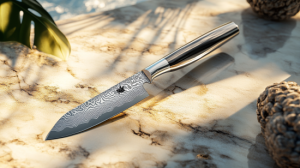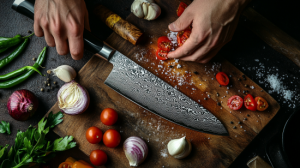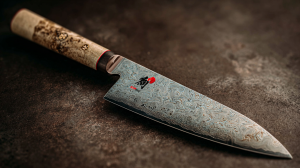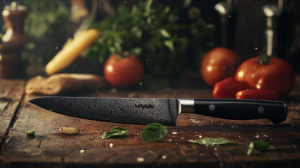

Miyabi Birchwood SG2 6″ Utility Knife
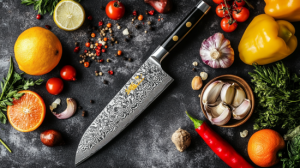
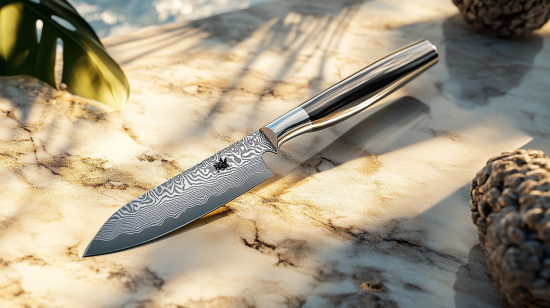
- Constructed of SG2 micro-carbide steel with Damascus design, total of 101 layers
- Blade features a Katana 9.5 to 12° edge, hand-honed using the traditional 3-step Japanese Honbazuke method
- 5000MCD, Cryodur ice-hardened to 63 Rockwell hardness; rounded spine and heel
- Traditional Japanese D-shape handle made of Karelian Birchwood; the only wood ever used in a Faberge egg
- Handle features a mosaic pin accent with two red spacers and stainless engraved end cap
- Handcrafted in Seki, Japan with a lifetime warranty; hand-wash only
$259.95
Elevating Your Kitchen Experience Through Japanese Craftsmanship
As I stood in my kitchen last weekend, facing a mountain of prep work for a dinner party, I reached for my most trusted ally – my Miyabi utility knife. There’s something deeply satisfying about the way it slices through a ripe tomato with barely any pressure, leaving perfect, paper-thin slices without crushing the delicate flesh. That moment reminded me why investing in a quality utility knife transforms everyday cooking from a chore into a pleasure.
I’ve been cooking professionally and at home for over fifteen years, and in that time I’ve learned that few kitchen investments pay off quite like a premium utility knife. Today, I want to share everything I’ve discovered about Miyabi utility knives – from their storied craftsmanship to practical buying advice that will help you make the right choice for your kitchen.
What Makes Miyabi Utility Knives Special?
My journey with Japanese knives began almost a decade ago, but it wasn’t until I held a Miyabi that I truly understood what exceptional craftsmanship feels like. Miyabi knives are produced in Seki, Japan – a city with a 700-year sword-making legacy. This heritage isn’t just marketing talk; you can feel it the moment you hold one.
Miyabi’s utility knives occupy that perfect middle ground between a chef’s knife and a paring knife. They’re designed for precision tasks that require more control than a large chef’s knife allows, but more reach than a small paring knife provides. The first time I used mine to butterfly a chicken breast, I was amazed at how effortlessly it moved through the meat with surgical precision.
Understanding What a Utility Knife Is Actually For
Before diving into the specifics of Miyabi, let’s clarify what makes a utility knife unique in your kitchen arsenal. I often describe it as the “problem solver” knife – that go-to tool when other knives aren’t quite right for the job.
A utility knife excels at medium-sized tasks: slicing sandwiches, cutting citrus, trimming vegetables, portioning small cuts of meat, and detailed prep work. It’s the knife I reach for when cutting an apple into perfect wedges, slicing a sandwich without crushing it, or trimming fat from a chicken thigh.
What makes these tasks perfect for a utility knife is the combination of maneuverability and precision. When I’m working with smaller ingredients where a chef’s knife feels unwieldy but a paring knife doesn’t offer enough reach, the utility knife steps in as the perfect middle ground.
The Miyabi Utility Knife Specifications
Blade Length: Finding Your Perfect Fit
Miyabi utility knives typically range from 5 to 6 inches (130-150mm) in length. This might not sound like a significant difference, but in practice, those dimensions hit a sweet spot that makes the knife incredibly versatile.
I’ve found that this length provides enough blade for efficient cutting without sacrificing control. When I’m working with medium-sized produce like apples or trimming a chicken breast, the 5.5-inch blade on my Miyabi Birchwood SG2 offers the perfect reach. For comparison, most chef’s knives run 8-10 inches, while paring knives are usually around 3-4 inches.
Blade Materials: The Soul of the Knife
Where Miyabi truly distinguishes itself is in its blade materials. Most Miyabi utility knives feature exceptional Japanese steel that balances hardness, edge retention, and corrosion resistance. Depending on the collection, you’ll find different steel compositions:
The Miyabi Artisan SG2 collection uses powdered steel (MC63) with a Rockwell hardness of 63 HRC. The first time I used mine, I was astonished by how it maintained its edge even after weeks of daily use. When I finally needed to sharpen it, the edge came back quickly and held beautifully.
The Miyabi Birchwood SG2 line also uses MicroCarbide MC63 steel, which contains 100 layers of steel forming a stunning Damascus pattern. This isn’t just aesthetically pleasing – those layers contribute to performance, reducing friction as you cut.
The Miyabi Kaizen collection uses VG10 super steel core with 64 layers of steel, offering a slightly lower hardness (around 60 HRC) but exceptional durability. I’ve found this to be an excellent option for cooks who want premium performance without being overly precious about their knives.
The Miyabi Black collection features MC63 powder steel with a distinctive black finish achieved through a treatment process that enhances corrosion resistance. The edge retention is remarkable – I’ve gone months of regular use without needing to sharpen my Black utility knife.
Handle Materials and Ergonomics
A knife’s handle is just as important as its blade, and Miyabi offers several distinct handle styles across their collections:
The D-shaped Pakkawood handles on the Kaizen collection provide a secure, comfortable grip that naturally positions your hand correctly. The slight asymmetry helps prevent rotation in your hand, which I find particularly helpful during repetitive tasks like slicing multiple vegetables.
The Birchwood handles are stunning works of art – the birch is treated to enhance durability while maintaining its natural beauty. The lightweight nature of birch makes longer prep sessions more comfortable, reducing hand fatigue.
The Miyabi Black collection features Black Ash handles with steel rivets that complement the blade’s dark finish. The shape is slightly more Western in feel, making it an excellent transition knife for those used to European-style knives.
What I appreciate most about Miyabi handles is the attention to balance. The perfect balance point between blade and handle makes precision cutting feel almost effortless, reducing strain during long prep sessions.
Miyabi vs. Other Premium Utility Knives
Miyabi vs. Shun: A Friendly Rivalry
I’ve owned both Miyabi and Shun knives, and the comparison is fascinating. Both represent the pinnacle of Japanese knife making, but with subtle differences that might sway your preference.
Shun utility knives tend to feature a slightly different blade profile – often a bit more curved toward the tip. This makes them excellent for rocking motions when mincing herbs. Miyabi blades typically have a flatter profile that excels at push-cutting techniques.
In terms of steel, both brands use premium materials, but Miyabi’s higher-end collections often achieve a slightly higher Rockwell hardness. My Miyabi at 63 HRC holds an edge noticeably longer than my Shun Classic at 61 HRC.
The handle designs differ significantly. Shun typically features more rounded, symmetrical handles that feel comfortable regardless of hand size. Miyabi’s handles, particularly in the higher-end collections, often have subtle asymmetry that naturally positions your hand for optimal control.
Price points are comparable between equivalent lines, with both brands offering collections ranging from around $120 to $300+ for utility knives. The decision often comes down to which handle style feels better in your hand and whether you prefer Miyabi’s typically flatter blade profile or Shun’s slightly more curved edge.
Japanese vs. Western Utility Knives
Coming from a background using primarily Western knives, my transition to Miyabi revealed significant differences between Japanese and Western utility knife philosophies.
Western utility knives (like Wüsthof or Zwilling’s non-Japanese lines) typically feature thicker blades made from softer steel (typically 56-58 HRC). This makes them more durable for rough tasks but less capable of achieving and maintaining the razor-sharp edge of a Miyabi.
Miyabi utility knives, with their harder steel and thinner blades, excel at precision cutting. The first time I used my Miyabi to slice through ripe tomatoes, I was amazed at how it glided through without crushing the delicate flesh – something my Western knives struggled with despite regular sharpening.
The trade-off for this performance is that Japanese knives require more careful maintenance. My Miyabi demands proper cutting technique, hand washing, and careful storage, while my Western utility knives can handle a bit more abuse without chipping.
Performance Aspects: What to Expect from Your Miyabi
Sharpness: Redefining Your Expectations
The sharpness of a Miyabi utility knife is truly in a league of its own. Factory edges on Miyabi knives are typically sharpened to an angle of 9.5 to 12 degrees per side, compared to most Western knives at 20+ degrees. This creates an exceptionally keen edge that can slice through ingredients with minimal resistance.
I still remember the first time I used my Miyabi to slice paper-thin garlic. Instead of crushing or tearing the cloves as my previous knives did, the Miyabi glided through with such precision that I could almost see through the slices. This level of sharpness transforms your cooking experience, making precision cuts effortless.
Edge Retention: Longevity Through Technology
The high Rockwell hardness of Miyabi blades (typically 60-63 HRC) translates to exceptional edge retention. In practical terms, this means less frequent sharpening and consistent performance between maintenance sessions.
With my previous knives, I found myself honing before every cooking session and still noticed performance declining within a week or two. With my Miyabi utility knife, I can maintain peak performance for weeks of regular use before needing to touch it up. When I do sharpen it, the edge comes back quickly and holds beautifully.
Weight and Balance: The Precision Factor
Miyabi utility knives tend to be lighter than their Western counterparts, typically weighing between 4-5 ounces. This lightness, combined with exceptional balance, makes them feel like natural extensions of your hand during precise cutting tasks.
The first time I spent an hour prepping vegetables with my Miyabi, I noticed significantly less hand fatigue compared to my heavier Western knives. The knife’s balance point sits typically at or just ahead of the bolster, creating a natural forward momentum that assists cutting while maintaining precise control.
Practical Applications: What Can You Cut?
Fruit and Vegetable Mastery
A Miyabi utility knife excels at precision cutting of fruits and vegetables. The thin, sharp blade makes short work of everything from delicate herbs to firm root vegetables.
When I’m slicing apples for a tart, the Miyabi creates perfect, consistent slices without tearing or crushing the flesh. For tomatoes, it’s simply unmatched – even when the blade isn’t freshly sharpened, it still passes the “tomato test” with ease, cleanly slicing through the skin without pressure.
For detail work like hulling strawberries, peeling citrus, or creating garnishes, the utility knife’s size offers more control than a chef’s knife while providing more reach than a paring knife. It’s become my go-to for most vegetable prep when I don’t need the heft of a chef’s knife.
Protein Preparation
While not designed for breaking down large cuts, the Miyabi utility knife excels at trimming and portioning proteins. Its precision makes it perfect for removing silver skin from tenderloin, trimming fat from chicken, or portioning fish fillets.
I’ve found it particularly useful for butterflying chicken breasts or trimming silver skin from pork tenderloin. The blade length provides enough reach while the tip offers the precision needed for detailed work. For slicing cooked proteins like chicken breast or medium-rare steak, the sharp edge creates clean cuts without tearing the meat.
Sandwich and Cheese Cutting
The utility knife truly shines when cutting sandwiches, where its length and sharpness allow for clean slices without crushing the fillings. When I make a multi-layered club sandwich, my Miyabi cuts through all layers with a single, clean stroke – no more tomatoes squirting out or bread getting compressed.
For cheese, the thin blade reduces sticking compared to thicker knives. When slicing semi-soft cheeses like fontina or young cheddar, the knife glides through without dragging or causing the cheese to crumble. For harder cheeses, I still prefer a dedicated cheese knife, but the Miyabi handles most varieties admirably.
Caring for Your Investment
Proper Cleaning and Storage
One crucial aspect of owning a Miyabi utility knife is understanding that it requires more careful maintenance than standard kitchen knives. Proper care will ensure your knife remains a kitchen companion for decades rather than years.
Never put your Miyabi in the dishwasher. The harsh detergents and mechanical washing action can damage both the edge and the handle. Instead, hand wash with mild soap and warm water immediately after use, then dry thoroughly with a soft cloth.
For storage, I recommend either a magnetic knife strip, a wooden knife block with appropriately sized slots, or individual blade guards if storing in a drawer. The key is to protect the edge from contact with other utensils and prevent moisture from collecting on the blade or handle.
Sharpening Techniques
Sharpening a Miyabi requires different techniques than Western knives due to the harder steel and more acute edge angle. I’ve found the following approach works best:
For regular maintenance, a quality ceramic honing rod used with very light pressure helps realign the edge without removing material. Unlike Western knives that might be honed before each use, I find my Miyabi only needs honing every week or two of regular use.
When the knife does need proper sharpening, Japanese water stones provide the best results. I typically use a progression of 1000 grit for establishing the edge, followed by 3000 and 6000 grit for refining and polishing. The key is maintaining the factory angle of 9.5-12 degrees per side, which is significantly more acute than Western knives.
If you’re not comfortable sharpening yourself, find a professional who specializes in Japanese knives. Not all knife sharpening services are equipped to handle the harder steel and more acute angles of Miyabi blades.
Choosing the Right Miyabi Utility Knife for You
Collections Overview and Price Points
Miyabi offers several distinct collections, each with its own character and price point:
The Miyabi Birchwood SG2 collection represents their premium offering, with price points around $250-300 for a utility knife. The striking birch handles and 100-layer Damascus pattern make these as much art pieces as tools. I consider mine an heirloom piece that will last generations with proper care.
The Miyabi Artisan SG2 collection offers similar performance to the Birchwood but with D-shaped Pakkawood handles at a slightly lower price point of $200-250. The performance is nearly identical to the Birchwood, with the difference primarily in the handle material and aesthetic.
The Miyabi Kaizen collection, priced around $160-200, uses VG10 steel instead of SG2. While still exceptionally sharp, the edge retention is slightly lower than the SG2 models. I recommend this line for serious home cooks who want premium performance without the highest price tag.
The Miyabi Evolution collection offers a more Western-inspired design with a softer curve to the handle and FC61 fine carbide steel. Priced around $120-160, these make excellent “gateway” Japanese knives for those transitioning from Western styles.
Where to Purchase
Miyabi knives are available through several channels:
Specialty kitchen stores like Williams-Sonoma, Sur La Table, and Korin offer the advantage of being able to hold the knife before purchasing. This is my preferred method, as the feel of the knife in your hand is crucial to finding the right match.
Online retailers like Amazon and Cutlery and More offer competitive pricing and often the widest selection of models. Just be certain you’re buying from authorized retailers to ensure authenticity and warranty coverage.
Direct from Zwilling J.A. Henckels (Miyabi’s parent company) provides confidence in authenticity but sometimes at higher prices than other retailers.
Regardless of where you purchase, ensure the retailer has a good return policy in case the knife doesn’t feel right in your hand. A quality knife is a personal choice, and what works perfectly for one cook might not suit another.
Making Your Decision: Practical Considerations
Is a Miyabi Utility Knife Worth the Investment?
After years of using various kitchen knives, I firmly believe that a quality utility knife is one of the most worthwhile investments you can make in your kitchen equipment. The question becomes whether the premium price of a Miyabi is justified compared to less expensive alternatives.
For serious home cooks and professionals who use their knives daily, I unequivocally recommend Miyabi. The performance difference is noticeable, and the joy of using such a perfectly crafted tool actually makes cooking more enjoyable. I find myself looking for excuses to prep ingredients just to experience the precision and effortlessness of cutting with my Miyabi.
For occasional cooks or those on tighter budgets, the value proposition becomes more personal. Consider how much time you spend in the kitchen and how much you value precision in your cooking. Even if you only cook a few times a week, a quality knife can transform those experiences.
Professional vs. Home Use Considerations
For professional chefs, Miyabi utility knives offer the performance and edge retention needed in demanding kitchen environments. The razor-sharp edge and precision make detailed prep work faster and more consistent – a significant advantage when working under time pressure.
However, professional environments require consideration of how the knife will be treated by others. In busy kitchens where knives might be used by multiple people, the more affordable Miyabi lines like the Evolution or Kaizen might be more practical choices than the premium Birchwood or Black collections.
For home cooks, even the highest-end Miyabi represents a once-in-a-lifetime purchase when properly maintained. I view my Birchwood SG2 utility knife as an heirloom tool that will outlast me with proper care – a perspective that helps justify the premium price.
Miyabi Utility Knife Warranty and Support
All Miyabi knives come with a limited lifetime warranty that covers defects in materials and workmanship. This warranty specifically excludes damage from misuse, improper care, accidents, or normal wear and tear.
In practice, I’ve found Zwilling’s customer service (Miyabi’s parent company) to be excellent when addressing any issues. When a friend’s Miyabi developed a small spot of rust due to improper storage, customer service provided detailed guidance on removing it and preventing future problems.
For warranty service, you’ll typically need to provide proof of purchase from an authorized retailer, which is another reason to be cautious about where you buy your knife. The process usually involves sending the knife to their service center for evaluation before any repairs or replacements are made.
Final Thoughts: My Personal Experience
After using my Miyabi utility knife almost daily for years, I can confidently say it has transformed my cooking experience. There’s something deeply satisfying about using a tool of such exceptional quality – it elevates even the most mundane cutting tasks into something approaching mindfulness.
When I reflect on the cost spread across years of use, it amounts to pennies per day for a noticeably better cooking experience. Few kitchen investments have paid such consistent dividends in both performance and enjoyment.
If you’re on the fence about investing in a Miyabi utility knife, I encourage you to visit a specialty kitchen store and simply hold one. Cut a tomato, slice a piece of paper, feel the balance. The experience typically sells itself in a way that no review can fully capture.
In a world of mass-produced mediocrity, tools like Miyabi knives represent the alternative: objects made with care, designed to perform exceptionally and last for generations. My Miyabi utility knife has become more than just a tool – it’s a daily reminder that quality matters, and that cooking with exceptional equipment can transform a chore into a pleasure.
Whether you’re a professional chef, a dedicated home cook, or someone just beginning to explore serious cooking, a Miyabi utility knife represents not just a purchase, but an investment in your daily experience of food preparation. It’s an investment I’ve never regretted making.