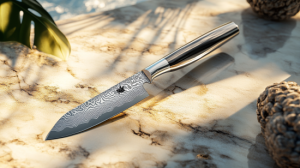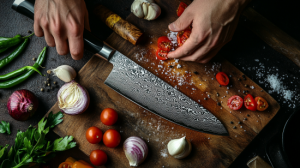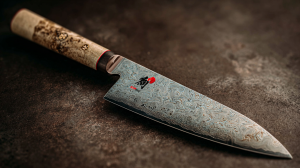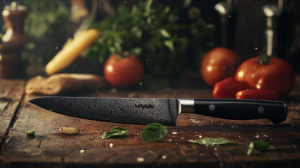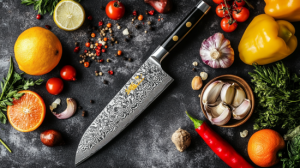
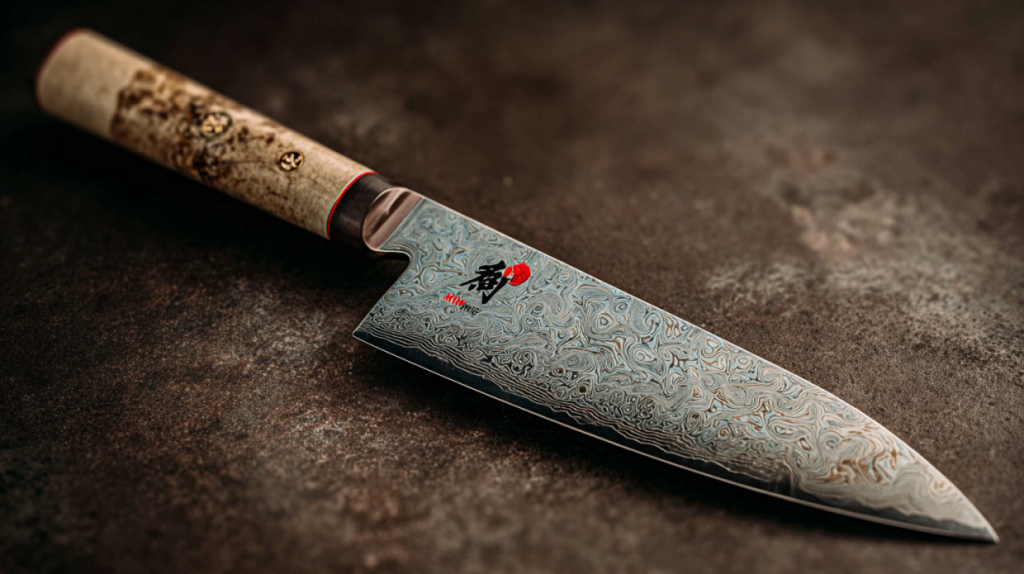

Miyabi Koh 8″ Chef’s Knife
- Constructed of revolutionary FC61 fine carbide stainless steel (4000FC) with 61 Rockwell hardness; hand-engraved Miyabi logo on blade
- Full-tang ice-hardened Friodur2 blade with sandblasted Katana edge offers exceptional durability, cutting edge retention
- Hand-honed 12° blade angle boasts scalpel-like sharpness; rounded spine, bolster and heel offer tireless cutting; corrosion resistant
- Faceted pakkawood handle is individually weight adjusted with 9-step finishing process; mosaic accent
- Handcrafted by 46 expert artisans in Seki, Japan with a lifetime warranty; hand-wash only
$129.95
Discovering Japanese Craftsmanship in My Western Kitchen
When I first held the Miyabi Koh 8″ Chef’s Knife in my hands, I knew my culinary journey was about to change forever. The perfectly balanced weight, the extraordinary sharpness that sliced through a tomato with barely any pressure, and the elegant minimalist design immediately told me this wasn’t just another kitchen tool—it was an extension of my cooking passion. After three years of daily use, countless meals prepared, and even a cooking class where I proudly showcased my prized possession, I’m sharing my comprehensive experience with what has become the most transformative kitchen investment I’ve ever made.
The Beginning of My Miyabi Journey
My relationship with knives has always been complicated. Growing up in a household where cooking was more functional than artistic, I never understood the obsession some chefs had with their knives. That changed when I moved into my first apartment and started cooking seriously. The cheap knife set I’d received as a housewarming gift was frustrating—dulling quickly, feeling uncomfortable in my hand, and making precise cuts nearly impossible.
I started researching quality knives, reading countless reviews, and even visiting specialty stores to test different models. The price tags were shocking at first—could a single knife really be worth $200 or more? But then I held the Miyabi Koh 8″ Chef’s Knife, and suddenly the investment made perfect sense.
Understanding the Miyabi Legacy
Before diving into the specifics of the Koh, it’s worth understanding what makes Miyabi knives special. The brand is owned by Zwilling J.A. Henckels, a German company with centuries of knife-making experience, but Miyabi knives are crafted in Seki, Japan—a city renowned for bladesmithing since the 13th century. This marriage of German engineering and Japanese craftsmanship creates something truly unique.
Miyabi offers several lines of knives, each with different characteristics and price points. The Koh line represents their entry point into authentic Japanese knives, making it perfect for home chefs looking to upgrade without spending a fortune on the higher-end Miyabi collections like Birchwood or Black.
What Makes the Miyabi Koh 8″ Chef’s Knife Stand Out?
The Miyabi Koh isn’t just another chef’s knife—it’s a carefully crafted tool that brings traditional Japanese knife-making techniques to Western kitchens. Here’s what makes it exceptional:
The Blade: A Masterpiece of Metallurgy
The heart of this knife is its FC61 fine carbide stainless steel blade. This isn’t your ordinary stainless steel—it’s a specialized high-carbon formulation that provides exceptional sharpness and edge retention. The blade undergoes a process called ice-hardening, where the steel is cooled to -196°C, creating a blade with extraordinary hardness (61 Rockwell hardness scale) while maintaining enough flexibility to prevent brittleness.
What immediately struck me was the thinness of the blade. Unlike Western-style chef’s knives that tend to be thicker and heavier, the Koh features a thinner profile that allows for incredibly precise cuts. The blade is sharpened to a breathtaking 9.5-12 degree angle per side, creating an edge so sharp that I actually cut myself the first time I washed it—a rookie mistake I won’t repeat!
The blade also features a traditional Japanese Honbazuke honing method, where the knife is sharpened in three steps using whetstones. This creates that remarkable edge that can slice through paper or tomatoes without resistance.
Perhaps most visually striking is the Tsuchime finish, which creates a hammered texture on the blade. Beyond being aesthetically pleasing, this design helps prevent food from sticking to the blade—a practical feature I’ve come to appreciate when making quick work of vegetables for stir-fries or salads.
The Handle: Form Meets Function
The handle of the Koh is a black polymer that at first glance might seem basic compared to the beautiful pakkawood or birchwood handles on more expensive Miyabi lines. However, after extended use, I’ve come to appreciate its practical benefits.
The handle is durable and incredibly easy to clean—important when you’re handling raw meat or sticky ingredients. It provides excellent grip even with wet hands (a common issue in busy kitchens), and the ergonomic design fits comfortably in both large and smaller hands.
The traditional Japanese D-shaped handle contour naturally fits the curve of your palm, reducing fatigue during extended prep sessions. I’ve spent hours prepping for dinner parties without the hand cramping I used to experience with my old knives.
One thing worth noting—the handle is designed for right-handed users. While lefties can certainly use the knife, it may not feel as naturally comfortable. If you’re left-handed, you might want to test the knife before purchasing.
Balance and Weight: The Perfect Equilibrium
When I first held the Miyabi Koh, the balance immediately impressed me. Weighing approximately 7 ounces, it strikes an ideal balance between the heavier German knives and ultra-lightweight Japanese counterparts.
The knife’s balance point sits perfectly at the bolster (the thicker part where the blade meets the handle), creating what knife enthusiasts call “neutral balance.” This means the knife neither feels blade-heavy nor handle-heavy, allowing for precise control and reducing wrist strain during extended use.
This balance translates into performance. Whether I’m rocking the knife through herbs, precision-slicing fish for sashimi, or handling tougher tasks like breaking down a chicken, the knife feels confident and controlled in my hand.
The Versatility of a True Chef’s Knife
A chef’s knife is meant to be the workhorse of your kitchen, and the Miyabi Koh certainly lives up to this expectation. Over the years, I’ve used it for virtually every cutting task imaginable:
Protein Preparation
The knife’s exceptional sharpness makes it ideal for all types of protein. When slicing raw chicken breast for stir-fry, the knife glides through without tearing the meat. For beef, whether it’s breaking down a larger cut or slicing a finished steak, the clean cuts help preserve the juiciness of the meat.
Perhaps most impressive is how the knife handles fish. The thin, sharp blade makes it possible to fillet with precision or create paper-thin slices for ceviche or carpaccio—tasks that would be difficult with a thicker Western knife.
Vegetable Mastery
This is where the Miyabi Koh truly shines. The blade’s sharpness makes quick work of everything from tough root vegetables to delicate herbs:
- Dicing onions becomes effortless, with clean cuts that minimize the tear-inducing compounds released
- Julienning carrots or other vegetables for stir-fries creates uniform pieces that cook evenly
- Even challenging items like butternut squash yield to the blade’s edge more easily than with lesser knives
- Mincing garlic and herbs happens with precision, releasing more flavor compounds without bruising
The blade’s thin profile excels at precise vegetable work that might otherwise require a specialized knife. I’ve found I reach for my nakiri (vegetable knife) far less frequently since getting the Koh.
All-Around Utility
Beyond proteins and vegetables, the knife handles virtually any kitchen task with ease:
- Slicing bread (though not as specialized as a proper bread knife)
- Chopping nuts and seeds
- Cutting fruit with precision
- Even light boning work, though I wouldn’t recommend it for heavy-duty butchery
The versatility means I use this knife for approximately 90% of my kitchen cutting tasks, making it an incredible value despite its premium price point.
Comparing the Miyabi Koh to Other Premium Knives
When I was deciding on which knife to purchase, I compared the Koh to several other options. Here’s how it stacks up:
Miyabi Koh vs. Other Miyabi Lines
The Koh represents Miyabi’s entry point, with higher-end lines like the Artisan, Birchwood, and Black commanding significantly higher prices. The primary differences are:
- Handle materials: The Koh uses a polymer handle, while higher lines use premium woods like birch or pakkawood
- Steel formulation: While the FC61 steel in the Koh is excellent, the SG2 powdered steel in lines like the Birchwood offers even better edge retention
- Aesthetic details: The higher lines feature more decorative Damascus patterns or hammered finishes
- Price: The Koh typically costs between $130-180, while higher-end Miyabi knives can range from $200-400+
After testing several Miyabi knives, I determined that the Koh offered the best value. It provides 90% of the performance of the premium lines at roughly half the price. The main differences are aesthetic or relate to edge retention over very long periods—not everyday performance.
Miyabi Koh vs. Shun Classic
Shun is perhaps Miyabi’s most direct competitor in the Japanese knife market. The Shun Classic, at a similar price point to the Koh, offers:
- VG-MAX steel with a 61-62 Rockwell hardness (comparable to the Koh)
- A more decorative Damascus pattern on the blade
- A pakkawood handle that some find more attractive than the Koh’s polymer handle
In terms of performance, I found the knives fairly comparable, with the Koh offering a slightly thinner blade that excels at precision work. The Shun has a slightly more Western-friendly profile with a bit more belly curve for rocking cuts.
My decision came down to the feel in hand—the Koh simply felt better balanced to me, though this is highly subjective and depends on hand size and cutting style.
Miyabi Koh vs. Western Knives (Wüsthof, Zwilling Pro)
Coming from Western knives, the differences were immediately apparent:
- Cutting angle: The Koh’s 9.5-12 degree angle is significantly sharper than the typical 20-22 degree Western edge
- Hardness: At 61 HRC, the Koh is harder than most Western knives (typically 56-58 HRC)
- Blade thickness: The Koh’s thinner profile allows for more precise cuts but may not be as suitable for heavy-duty tasks
- Weight: The Koh is lighter than comparable German knives, reducing fatigue during extended prep
The Miyabi Koh represents a nice middle ground between traditional Japanese knives (which can be extremely thin and specialized) and Western workhorses. It offers the sharpness and precision of Japanese design with enough robustness to handle everyday Western kitchen tasks.
The Investment: Price Considerations
The Miyabi Koh 8″ Chef’s Knife typically retails between $130-180 depending on sales and retailers. This positions it as a premium knife, but at the lower end of the truly high-quality chef’s knife range.
When I first considered spending this much on a single knife, I had serious doubts. However, after three years of daily use, I can confidently say it was one of the best kitchen investments I’ve made. Here’s why:
- Longevity: With proper care, this knife will last decades, making the per-year cost minimal
- Performance: The time saved and enjoyment added to daily cooking is difficult to quantify but significant
- Versatility: Replacing 3-4 lesser knives with one excellent chef’s knife actually saved me money
- Enjoyment: Cooking with a truly sharp, well-balanced knife turns food prep from a chore into a pleasure
For context, many professional chefs spend $300+ on their primary knife, making the Koh an excellent value for nearly professional-level performance.
Where to Purchase the Miyabi Koh
The Miyabi Koh is available from several retailers:
- Specialty kitchenware stores (Sur La Table, Williams-Sonoma)
- Department stores with quality kitchen departments
- Online retailers
- Direct from Zwilling/Miyabi’s website
In my experience, it’s best to purchase from an authorized retailer to ensure authenticity and warranty coverage. The knife typically comes with a limited manufacturer’s warranty against defects in materials and workmanship, though this doesn’t cover normal wear or improper use.
I recommend purchasing from a physical store if possible, as holding the knife before buying allows you to assess the comfort and balance personally. However, reputable online retailers have good return policies if the knife doesn’t meet your expectations.
Proper Care and Maintenance: Protecting Your Investment
A knife of this quality deserves proper care. Here’s how I maintain my Miyabi Koh to keep it performing at its best:
Daily Care
- Hand washing only: Never put this knife in the dishwasher, as the harsh detergents and mechanical action will damage both the edge and the handle. I wash mine with mild dish soap and warm water immediately after use.
- Immediate drying: After washing, I thoroughly dry the knife with a soft cloth to prevent water spots or potential rusting.
- Proper storage: I store the knife either on a magnetic strip (ensuring it doesn’t clash with other knives) or in a knife guard in my drawer. Never leave it loose in a drawer where it can bang against other utensils.
- Cutting surface: I always use wood or soft plastic cutting boards. Glass, marble, or granite boards will quickly dull the fine edge.
Sharpening and Honing
This is where many knife owners make mistakes:
- Honing vs. Sharpening: It’s crucial to understand the difference. Honing realigns the edge without removing material, while sharpening actually grinds away steel to create a new edge.
- Regular honing: I use a ceramic honing rod (never steel for this knife) once a week or whenever the knife feels less keen. The technique is important—maintain the proper angle and use gentle pressure.
- Professional sharpening: For actual resharpening, I either use Japanese water stones (a skill I’m still perfecting) or take the knife to a professional who specializes in Japanese knives about twice a year.
- Avoiding electric sharpeners: Most electric sharpeners are too aggressive for this fine-edged knife and can damage the blade geometry.
With proper care, the knife holds its edge remarkably well. I typically go 3-4 months of daily use before noticing any significant decline in performance, and even then, a quick honing usually restores much of the edge.
Is the Miyabi Koh Right for Every Cook?
While I love this knife, it’s not necessarily the perfect choice for everyone. Here’s who might benefit most from the Miyabi Koh:
Ideal for:
- Home cooks looking to upgrade from basic knives to their first premium blade
- Cooks who appreciate precision and sharpness
- Those who prefer lighter knives with exceptional balance
- People willing to hand wash and properly maintain their knives
- Cooks who want Japanese knife performance with Western-friendly ergonomics
May not be ideal for:
- Complete novices who aren’t ready to care for a fine edge
- Cooks who prefer the heft and durability of traditional German knives
- Those who use a lot of force or cutting techniques like “rock chopping”
- Left-handed users (though it can still work for them)
- People looking for a dishwasher-safe option
The Pros and Cons: An Honest Assessment
After years of use, I’ve identified clear strengths and limitations of the Miyabi Koh:
Pros:
- Exceptional sharpness out of the box and excellent edge retention
- Perfect balance and comfortable ergonomics for extended use
- Versatility across almost all kitchen cutting tasks
- Durability of both blade and handle with proper care
- Value for the performance level compared to more expensive knives
- Elegant aesthetic that makes cooking more enjoyable
- Easy maintenance with simple daily care
Cons:
- Not dishwasher safe (though no fine knife truly is)
- Requires careful handling to protect the fine edge
- Not ideal for heavy-duty tasks like cutting through bone or frozen foods
- Polymer handle lacks the premium feel of wood handles on higher-end models
- Right-handed design may not be ideal for lefties
My Personal Experience After Three Years
Looking back on three years with this knife, I can honestly say it’s transformed my cooking experience. Food preparation has become more precise, more efficient, and genuinely more enjoyable.
I remember the first time I used the knife to prepare a special anniversary dinner for my partner. Slicing shallots paper-thin, dicing vegetables for mirepoix with surgical precision, and portioning a tenderloin into perfectly even medallions—the knife made every step feel effortless and elevated the final presentation of the meal.
Even everyday tasks like preparing weeknight stir-fries or quickly chopping vegetables for soups have become more pleasurable. The knife’s performance has remained consistent, with only occasional honing and twice-yearly professional sharpening keeping it in excellent condition.
The most telling endorsement? When friends who enjoy cooking visit and use the knife, they invariably ask about it—and several have purchased their own Miyabi Koh after experiencing the difference firsthand.
Final Thoughts: Is It Worth the Investment?
If you’re serious about cooking and can commit to proper knife care, the Miyabi Koh 8″ Chef’s Knife represents one of the best values in premium kitchen cutlery. It offers nearly professional-level performance at a price point that, while substantial, is justified by its versatility, longevity, and the daily pleasure it brings to food preparation.
For me, the investment has paid dividends not just in better food and more efficient preparation, but in the simple joy of using a tool that performs its function with such excellence. In a world of disposable products, there’s something deeply satisfying about owning and using a tool crafted with such care and precision—one that gets better with age and proper maintenance.
Whether you’re looking to purchase your first serious knife or adding to a growing collection, the Miyabi Koh deserves serious consideration. Just be warned: once you experience cooking with a knife of this caliber, it’s hard to go back to anything less.