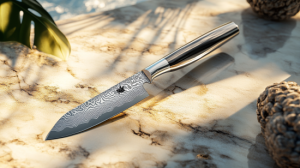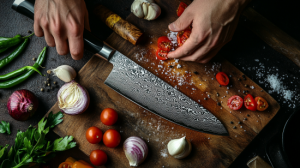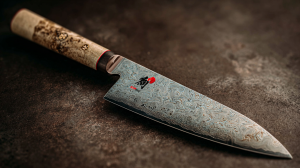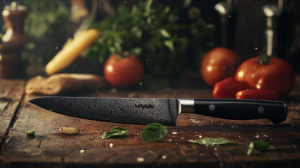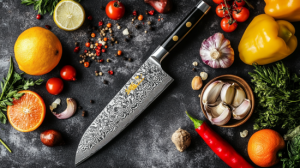
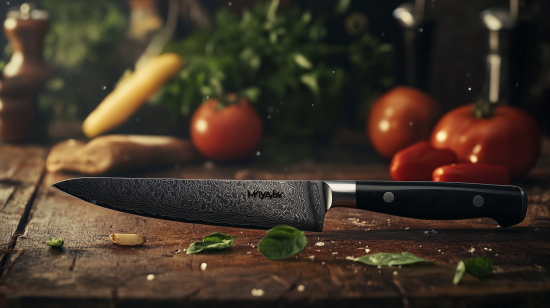

Miyabi Evolution 8″ Chef’s Knife
- Constructed of revolutionary FC61 fine carbide steel (400FC); 61 Rockwell hardness
- Ice-hardened Friodurx2 blade offers exceptional durability, cutting edge retention, and corrosion resistance
- 12° blade angle boasts scalpel-like sharpness; rounded spine and heel offer tireless cutting
- Ergonomic, triple-riveted POM handle with red spacers nestles comfortably in the hand
- Time-tested German engineering meets Japanese craftsmanship
- Handcrafted by expert artisans in Seki, Japan with a lifetime warranty; hand-wash only
$129.95
From Home Cook to Kitchen Connoisseur: My Journey with Japanese Blade Perfection
When I first held a Miyabi Evolution chef knife in my hands, I knew my kitchen experience would never be the same. The perfect balance, the incredible edge, the way it seemed to anticipate my movements—this wasn’t just a knife; it was an extension of my culinary ambitions. After three years of daily use and countless meals later, I’m sharing everything you need to know before investing in what might be the best kitchen tool you’ll ever own.
As someone who’s gone from burning scrambled eggs to hosting dinner parties that my friends actually look forward to, I can tell you that the right knife doesn’t just change how you cook—it transforms your entire relationship with food.
The Miyabi Evolution: More Than Just a Pretty Blade
The first thing you’ll notice about the Miyabi Evolution is its striking appearance. But make no mistake—this knife isn’t just about looks. Before I invested in mine, I spent weeks researching, comparing, and even testing different high-end knives. The Evolution stood out immediately.
The Evolution line represents Miyabi’s thoughtful fusion of Western and Japanese knife-making traditions. While traditional Japanese knives can be intimidating for home cooks (I know they were for me), the Evolution series offers that same precision and craftsmanship but with user-friendly features that make it accessible to everyone from beginners to professionals.
What truly separates this knife from others in my collection is the perfect harmony between the ultra-sharp edge of a traditional Japanese knife and the comfortable, Western-style handle. It manages to be both a statement piece and a workhorse—something surprisingly rare in the world of high-end cutlery.
The Science Behind the Slice: Understanding the Blade
The heart of any chef’s knife is its blade, and the Miyabi Evolution’s is exceptional. The knife features an FC61 fine carbide stainless steel core with a Rockwell hardness of 61 HRC. Now, I’m not a metallurgist, but after using knives of varying quality for years, I can tell you that this rating matters enormously.
The 61 HRC hardness means this blade holds its edge remarkably well. For context, many Western knives clock in around 56-58 HRC. That difference might seem small, but it translates to significantly less frequent sharpening. I used to sharpen my previous chef’s knife every few weeks; with the Evolution, I can go months with just occasional honing before it needs proper sharpening.
The blade undergoes Miyabi’s signature Cryodur ice-hardening process. Without getting too technical, this involves freezing the metal to extremely low temperatures during manufacturing, creating a more durable, corrosion-resistant blade with superior edge retention. The result is a blade that remains razor-sharp through extensive use.
Perhaps most impressive is the blade’s construction using what Miyabi calls the “Honbazuke method”—a traditional Japanese three-step honing process that creates an incredibly sharp 9-12 degree edge on each side. Compare that to the typical 20-22 degree edge on Western knives, and you begin to understand why this knife glides through ingredients with such minimal resistance.
The Handle: Where Comfort Meets Control
Before owning the Evolution, I’d experienced hand fatigue during longer cooking sessions. The Evolution’s handle has completely eliminated that issue. Crafted from black PakkaWood (a composite material that combines real hardwood with resin), it offers both the aesthetic appeal of wood and the durability of synthetic materials.
The D-shaped ergonomic design fits naturally in my hand, reducing strain during extended use. There’s a subtle ridge where your fingers rest that provides remarkable control, which is crucial when you’re working with a blade this sharp. The handle is also moisture-resistant and won’t warp or crack like traditional wooden handles might.
The steel end cap isn’t just decorative—it provides perfect balance. The knife feels neither blade-heavy nor handle-heavy; it simply feels right. This balance point makes precise cutting tasks significantly easier, whether you’re julienning carrots or breaking down a chicken.
Size Options: Finding Your Perfect Fit
The Evolution chef’s knife comes in multiple sizes, typically 8-inch (20cm) and 10-inch (25cm) versions, though you might occasionally find other sizes. I opted for the 8-inch as it’s the most versatile for home kitchens, but the choice comes down to personal preference and kitchen needs.
If you have smaller hands or a compact kitchen, the 8-inch model provides excellent control while still being large enough for most tasks. The 10-inch offers more blade surface for larger ingredients but requires more clearance and can be slightly more intimidating for new users.
After using my 8-inch Evolution for everything from mincing herbs to breaking down watermelons, I can confidently say it handles nearly all kitchen tasks with ease. However, if I were doing it over again, I might consider the 10-inch simply because I’ve grown more confident in my knife skills and occasionally work with larger ingredients.
Performance: Where the Miyabi Evolution Truly Shines
The true test of any knife is how it performs under real cooking conditions, not just how it looks in a display case. I’ve put my Evolution through everything from delicate herb work to tough squash breakdown, and its performance has been consistently impressive.
The first thing you’ll notice when using this knife is how effortlessly it cuts. The combination of the ultra-thin edge angle and the hardened steel creates what I can only describe as a “falling through” sensation—the knife seems to move through ingredients with virtually no resistance. Slicing tomatoes, often the benchmark test for knife sharpness, becomes almost comically easy. You can achieve paper-thin slices without squashing the fruit.
The blade’s hardness allows for exceptional precision. When julienning carrots or creating a brunoise of vegetables, the cuts are clean and exact. There’s none of the crushing or tearing that happens with duller or lower-quality knives. This precision extends to meat preparation as well—trimming silver skin from a tenderloin or portioning chicken becomes a much more controlled process.
Edge retention is where the Evolution truly earns its keep. After three years of near-daily use, I’m still amazed by how well it holds its edge. While no knife stays razor-sharp forever, the Evolution significantly outperforms other knives in my collection. With regular honing (I use a ceramic honing rod weekly), the knife maintains its performance for months between proper sharpenings.
The blade’s profile features a gentle curve that allows for both Western-style rocking cuts and the straight up-and-down chopping favored in Japanese cutting techniques. This versatility means you don’t have to adapt your cutting style to the knife—it adapts to you.
Miyabi Evolution vs. Other Miyabi Lines
Miyabi offers several knife lines, each with distinct characteristics. After researching extensively (and now having added a Miyabi Birchwood to my collection as well), I can offer some comparisons.
The Evolution sits in what I’d call the “accessible premium” category within Miyabi’s lineup. The Miyabi Artisan SG2 and Birchwood SG2 lines feature more premium materials and even harder steel (63-64 HRC), but come with significantly higher price tags. The Evolution offers much of the same performance at a more approachable price point.
Compared to the Miyabi Kaizen, the Evolution features a more Western-friendly handle design while maintaining similar blade performance. The Kaizen’s handle is more traditional Japanese in style, which some users find less comfortable for extended use.
The Entry-level Miyabi Koh line is more affordable but uses slightly lower-grade steel (FC61 vs. the Evolution’s treated FC61) and lacks some of the refinement in the handle and finish.
After using both the Evolution and the Birchwood extensively, I’d say the primary difference is in aesthetics and the marginally better edge retention of the Birchwood’s SG2 steel. For most home cooks, the Evolution provides nearly identical cutting performance at a more reasonable price point.
Miyabi Evolution vs. Shun: The Great Debate
No discussion of premium Japanese kitchen knives would be complete without addressing the Shun comparison. Shun knives, particularly their Classic line, are often the first high-end Japanese knives many home cooks encounter.
I’ve used both extensively, and the differences are subtle but meaningful. The Shun Classic uses VG-MAX steel (61 HRC, similar to the Evolution) with a Damascus pattern overlay. The Evolution has a cleaner aesthetic with its polished blade but lacks the patterned look that some cooks prefer.
In terms of performance, both are exceptional, but I find the Evolution’s balance and handle more comfortable during extended use. The Shun Classic has a slightly more rounded handle that some users prefer, but the Evolution’s D-shaped handle provides more definite hand positioning.
Edge retention is comparable between the two, though in my experience, the Evolution’s edge seems to withstand abuse slightly better. When it comes to price, the Evolution typically runs 10-15% less than comparable Shun models, making it a better value in my opinion.
The Practical Stuff: Care and Maintenance
Owning a knife of this caliber comes with responsibilities. First and foremost: this knife is absolutely not dishwasher safe. The high heat, harsh detergents, and potential for the blade to hit other items will damage both the edge and the handle. I always hand wash mine immediately after use with gentle soap and warm water, then dry it thoroughly.
For regular maintenance, I use a ceramic honing rod (not a steel one, which could be too abrasive for this hardened blade) once a week or before major cooking projects. This realigns the microscopic edge rather than removing material.
When the knife eventually needs proper sharpening, I’d recommend using whetstones if you’re comfortable with that process. I use a combination of 1000 and 6000 grit stones, which restore the edge beautifully. If you’re not confident with whetstones, find a professional sharpening service that specializes in Japanese knives—not all knife sharpeners are created equal, and the specific edge angle of the Evolution requires appropriate attention.
For storage, I keep mine in a knife block with horizontal slots to prevent the edge from resting on anything. Edge guards work well too if you store knives in a drawer, but never let the blade rattle around unprotected.
The Investment: Is the Price Tag Justified?
Let’s address the elephant in the room: the Miyabi Evolution isn’t cheap. With prices typically ranging from $160-200 for the 8-inch chef’s knife (and sometimes more depending on retailer and sales), it represents a significant investment for many home cooks.
After three years of daily use, I can unequivocally say that the Miyabi Evolution offers exceptional value despite its premium price. When broken down over the lifespan of the knife (easily 10-15 years with proper care), the cost per use becomes remarkably reasonable—pennies per cooking session for a tool that makes every cutting task more efficient and enjoyable.
What justifies the price isn’t just the premium materials or the craftsmanship—it’s the cumulative effect of every small improvement over lesser knives. The time saved on prep work, the reduced hand fatigue, the consistency of the cuts, and yes, the pure enjoyment of using a tool that performs beautifully all contribute to its value proposition.
For those looking to purchase, I’ve found that specialty kitchen stores often offer the chance to hold and sometimes test knives before buying—an opportunity worth taking advantage of. Online, retailers like Sur La Table, Williams Sonoma, and even Amazon offer the Evolution, though prices can vary significantly. Watch for sales, particularly around major shopping holidays.
Most retailers selling Miyabi knives honor the manufacturer’s limited lifetime warranty against defects in materials and workmanship. This doesn’t cover normal wear or damage from misuse, but it does provide some peace of mind with your purchase.
Everyday Applications: What Can You Cut?
A better question might be: what can’t you cut? The versatility of the Evolution chef’s knife is remarkable. I use mine for:
- Vegetables of all types: From the softest tomatoes to the hardest butternut squash
- Proteins: Trimming, portioning, and even light butchery of chicken, beef, pork, and fish
- Herbs: Precise mincing without bruising delicate leaves
- Fruits: Clean, controlled slices of everything from apples to watermelon
- Bread: Though not its primary purpose, it handles softer breads adequately
The only tasks I avoid are those that might damage the edge: cutting frozen foods, hacking through bones, or attempting to cut on surfaces like stone or glass. For these tasks, I use more specialized tools (a cleaver for bones, a serrated knife for crusty bread, etc.).
The knife’s versatility means you can achieve professional-looking results across a wide range of preparations. My brunoise has become significantly more uniform, my herb chiffonade more delicate, and my meat portioning more precise—all contributing to better final dishes.
The Pros and Cons: An Honest Assessment
After years of use, I can offer a balanced view of the Evolution’s strengths and limitations.
Pros:
- Exceptional sharpness that makes prep work faster and more precise
- Superior edge retention compared to Western knives
- Excellent balance and ergonomics for reduced fatigue
- Versatile profile suitable for multiple cutting techniques
- Durable construction that will last for many years with proper care
- Visually appealing without being flashy
- More accessible price point than many comparable Japanese knives
Cons:
- Requires more careful maintenance than standard kitchen knives
- The harder steel is slightly more prone to chipping if misused
- Not suitable for heavy-duty tasks like bone cutting
- May require learning different cutting techniques to fully utilize its capabilities
- Initial cost is high compared to mass-market knives
For me, the pros dramatically outweigh the cons, but it’s important to understand what you’re investing in and whether your cooking style will benefit from these specific characteristics.
Is the Miyabi Evolution Right for Beginners?
This is a question I get frequently, and my answer has evolved over time. Initially, I would have recommended that beginners start with something more forgiving. Now, I believe the Evolution can actually be an excellent first serious knife—with some caveats.
The Evolution is approachable in a way that many Japanese knives aren’t. The Western-style handle is comfortable and familiar, and the balance makes it surprisingly easy to control. The sharpness, while requiring respect, actually makes cutting safer because you need less force (many kitchen accidents happen when dull knives slip).
However, beginners need to commit to proper care and handling practices from day one. This means learning proper knife skills, cutting on appropriate surfaces (wood or plastic boards only), and following the maintenance guidelines religiously.
If you’re just beginning your cooking journey but are serious about developing your skills, the Evolution could be the only chef’s knife you’ll need to buy for many years. Just be prepared for a learning curve—not because the knife is difficult to use, but because it’s capable of much more than a basic kitchen knife.
The Intangible Benefits: Joy in Cooking
There’s something that specifications and comparisons can’t capture: the pure enjoyment that comes from using a truly excellent tool. Every time I pick up my Evolution, there’s a moment of appreciation—for the craftsmanship, for the performance, and for how it enhances the cooking experience.
Cooking can be therapeutic, creative, and deeply satisfying when you have tools that don’t fight you. The Evolution removes friction from the process, making prep work less of a chore and more of a pleasure. This psychological benefit shouldn’t be underestimated—when you enjoy the process, you’re more likely to cook more often, experiment with new techniques, and grow as a cook.
My Final Verdict: A Worthwhile Investment
After thousands of meals and countless hours of use, my verdict is clear: the Miyabi Evolution chef knife is one of the best investments I’ve made in my kitchen. It strikes a remarkable balance between professional-grade performance and home cook accessibility.
While no knife is perfect for every user or every task, the Evolution comes remarkably close to being the ideal daily driver for serious home cooks and even professional chefs. Its combination of sharpness, edge retention, comfort, and versatility makes it suitable for nearly any kitchen task you’d use a chef’s knife for.
If you’re on the fence about making this investment, consider this: tools that make daily tasks more enjoyable ultimately improve your quality of life. The Miyabi Evolution doesn’t just cut food—it transforms the cooking experience from a necessity into a pleasure.
Whether you’re looking to elevate your cooking game, searching for a knife that will serve you reliably for years to come, or simply wanting to experience the difference that truly excellent cutlery can make, the Miyabi Evolution deserves your serious consideration. In a world of disposable goods and planned obsolescence, it stands as a reminder that quality craftsmanship and thoughtful design still matter—and are still worth paying for.
The next time you’re in your kitchen, knife in hand, imagine how different the experience could be. That’s what the Miyabi Evolution offers: not just a better knife, but a better relationship with cooking itself.