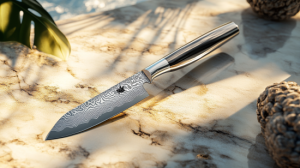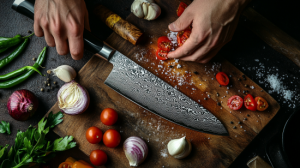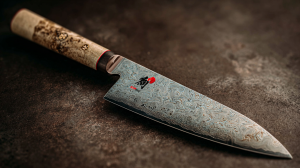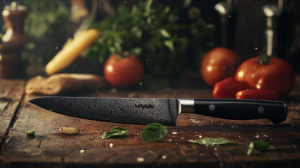
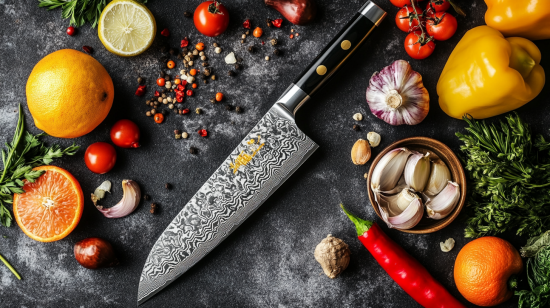

Miyabi Kaizen 6″ Chef’s Knife
- VG10 super steel (CMV60) encased by 64 layers of Damascus
- Damascus pattern uses a traditional 3-step Honbazuke technique
- 60 Rockwell Hardness; traditional Japanese blade hand-honed to a double bevel 9 to 12° angle
- Micarta D-shape handle with mosaic accent complimented by red spacers and a steel end-cap with logo
- Handcrafted by expert artisans in Seki, Japan with a lifetime warranty; hand-wash only
$169.95

6-inch, Chef’s Knife
- This 6-inch chef’s knife is designed specially for smaller hands and those that prefer a lighter style chef’s knife that lets you effortlessly slice, dice, and chop through prep work.
- MIYABI celebrates Japanese craftsmanship with Artisan. Using traditional methods and innovative techniques, these knives merge the past and present into an exceptional knife collection.
- The potent core of SG2 micro-carbide powder steel is layered in a stunning Tsuchime finish. This exquisite, hand-hammered effect helps prevent food from sticking. The CRYODUR® blades feature exceptional sharpness and durability thanks to their innovative, ice-hardening treatment. Each knife features a hand-honed blade finished with a true katana edge, a homage to the samurai swords made in Seki centuries ago.
- Crafted with special Cocobolo Rosewood Pakkawood, the handles mirror the beauty of the blade. Sophisticated details include brass and red spacers, a mosaic pin and a stainless-steel end cap. The attractive D-shaped handle is designed to nestle comfortably in your hand for tireless cutting.
- Crafted from revolutionary SG2 (MC63) micro-carbide powder steel – 63 Rockwell hardness
- Tsuchime hand-hammered finish prevents sticking
- Ice-hardened CRYODUR blade for exceptional durability, cutting edge retention, and corrosion resistance
- Hand-honed, 3-step Honbazuke blade boasts scalpel-like sharpness
- Authentic, thin Japanese blade profile – 9.5-12° edge angle
- Mirror-polished blade with sandblasted katana edge
- D-shaped, Cocobolo Rosewood Pakkawood handle
- Hand wash only
- Handcrafted in Seki, Japan
$189.99
A Professional Chef’s Deep Dive into the Perfect Compact Cutting Tool
As I run my fingers along the spine of my Miyabi 6-inch chef knife for what must be the thousandth time, I’m still amazed at how something so compact can feel so substantial. There’s a certain intimacy that develops between a chef and their favorite knife, and this Miyabi has become an extension of my hand in ways I never anticipated when I first made the switch from my bulkier 8-inch workhorse.
When I first started in professional kitchens fifteen years ago, bigger seemed better. The 8-inch chef knife was the undisputed king, and anything smaller was dismissed as inadequate. But after developing wrist issues three years ago, I reluctantly tried this more compact Miyabi on a colleague’s recommendation. The precision and control this knife offers completely transformed my approach to cooking, making me question everything I thought I knew about the “right” knife for a serious chef.
For those considering making a similar shift – or perhaps looking for their first truly high-quality chef knife – I want to share my comprehensive experience with the Miyabi 6-inch. This isn’t just a knife; it’s a precision instrument that deserves a thoughtful approach before investing.
What Exactly Is a 6-Inch Chef Knife For?
Before my conversion, I would have dismissed a 6-inch chef knife as merely a utility blade – something between a paring knife and a “real” chef knife. I couldn’t have been more wrong. The Miyabi 6-inch serves as a true all-purpose knife, particularly excelling at precision tasks that require nimble control.
In my day-to-day cooking, I’ve found this knife shines particularly bright when working with smaller ingredients. When I’m brunoise-cutting shallots, mincing herbs, or performing detailed work on vegetables, the shorter blade gives me significantly more control than my old 8-inch knife ever did. The reduced blade length means less rocking motion is needed, allowing for more controlled, precise cuts.
While my colleagues with larger hands still prefer their 8-inch counterparts for breaking down large cuts of meat or handling watermelons, I’ve found the 6-inch to be more than adequate for about 90% of my daily kitchen tasks. When I’m processing multiple pounds of vegetables for service, the reduced weight means less fatigue, which translates to more consistent cuts over extended periods.
The Miyabi 6-Inch vs. Traditional 8-Inch: An Honest Comparison
Making the switch from an 8-inch to a 6-inch chef knife isn’t just about choosing a smaller version of the same tool – it’s about embracing a different approach to cutting. Here’s what I’ve experienced in the transition:
Weight and Balance
The first thing I noticed when picking up the Miyabi 6-inch was its weight – approximately 6.2 ounces compared to my old 8-inch knife’s 8.5 ounces. While this might not sound like much, the difference becomes pronounced during extended prep sessions. After an hour of continuous chopping, my wrist and forearm experience noticeably less fatigue.
The balance point sits just forward of the bolster, creating a slightly blade-heavy feel that assists with chopping motions while still providing enough counterweight for precision work. In comparison, my old 8-inch knife had a more central balance that sometimes required more force to drive through denser ingredients.
Blade Coverage and Cutting Technique
The reduced blade length does require some adjustment to technique. With an 8-inch knife, I could easily rock-chop across a broader area, covering more cutting board real estate with each motion. The 6-inch requires more incremental movements, especially when dealing with larger ingredients.
I’ve adapted my technique to use more forward-focused cuts rather than the exaggerated rocking motion I used with larger knives. This actually promotes better knife skills and more conscious cutting, which has improved my overall technique.
Maneuverability and Control
Where the Miyabi 6-inch truly outshines its larger counterpart is in maneuverability. When cutting in confined spaces or performing intricate work, the shorter blade offers exceptional control. Coring tomatoes, deveining shrimp, or creating decorative cuts on small vegetables becomes significantly easier with the more nimble profile.
This improved control comes at a cost, though. When breaking down larger ingredients like cabbage or butternut squash, I sometimes miss the longer blade of my 8-inch knife. For these tasks, I occasionally revert to a larger knife, though I’ve largely adapted my technique to accommodate the 6-inch for most applications.
The Metallurgical Marvel: Understanding Miyabi’s Blade Construction
What truly sets the Miyabi apart from other knives in this size category is the exceptional blade construction. My particular model features their FC61 fine carbide steel, though Miyabi offers several steel variations across their different lines.
The Steel: Composition and Performance
The FC61 steel used in my knife contains approximately 0.61% carbon, which strikes an excellent balance between edge retention and ease of sharpening. It also contains chromium for corrosion resistance, though not in the quantities found in typical stainless steel.
What fascinates me about this particular steel is how it performs in real-world kitchen situations. After a full day of prep work, the edge still glides through tomato skin without pressure – a true test of sharpness retention. Even after three months of daily use, I only need to touch up the edge with a honing rod rather than performing a full resharpening.
The Rockwell hardness rating on my Miyabi 6-inch measures around 61 HRC, which is significantly harder than most Western knives (typically 54-56 HRC). This hardness allows for the exceptionally thin, acute edge that makes Japanese knives so revered, but it does require more careful handling to prevent chipping.
Blade Construction: The Layering Process
Many Miyabi lines feature traditional Japanese Damascus steel construction, with multiple layers folded and hammered together. My specific knife has 101 layers surrounding the core steel, creating the distinctive rippled pattern visible along the blade face.
Beyond aesthetics, these layers serve a practical purpose. The softer outer layers provide protection for the harder core steel, while also reducing food sticking to the blade during cutting – a phenomenon chefs call “food release.” I’ve noticed considerably less sticking when slicing through potatoes or apples compared to my previous single-steel knife.
The blade incorporates a traditional Japanese Honbazuke edge, hand-honed to a 9.5-12 degree angle per side. This incredibly acute angle (Western knives typically feature 20-22 degree angles) allows the knife to slice through ingredients with minimal resistance, reducing the force needed for clean cuts.
The Unseen Hero: Handle Design and Materials
While much attention is rightfully given to the blade, the handle of a chef’s knife is equally important for comfort during extended use. Miyabi offers several handle options across their different lines, with mine featuring their D-shaped Karelian Birch wood handle.
Handle Ergonomics
The D-shaped profile contours naturally to a right-handed grip (left-handed versions are available in some models). The subtle asymmetry provides tactile feedback about blade orientation without requiring visual confirmation – particularly useful during rapid chopping sequences.
At approximately 4.5 inches long, the handle accommodates my medium-sized hand perfectly, with enough room for a secure pinch grip while still allowing the heel of my hand to rest comfortably against the end cap. The slight swell toward the butt end prevents slipping during wet conditions.
Handle Materials
The Karelian Birch used in my knife handle offers excellent moisture resistance while providing a warm, organic feel compared to synthetic materials. After three years of daily use, the wood has developed a subtle patina that I find aesthetically pleasing without affecting grip performance.
Other Miyabi lines feature alternative handle materials, including:
- Black Pakkawood (a resin-impregnated hardwood composite)
- Micarta (a linen/resin composite)
- Traditional Japanese charred Magnolia (for their most traditional models)
Each material offers different performance characteristics, with the synthetic options providing better moisture resistance at the cost of the organic feel of natural wood.
Sharpness: Beyond the Factory Edge
The out-of-box sharpness of my Miyabi was genuinely impressive – easily shaving arm hair and slicing through hanging paper without tearing. However, as any chef knows, what matters most is how a knife performs after months of use and subsequent sharpenings.
Edge Retention
After three years of regular use, I’ve found the edge retention to be exceptional compared to Western knives I’ve owned. With proper technique (avoiding twisting motions or lateral pressure), I can typically go 3-4 weeks of daily professional use before noticing any decline in cutting performance.
When dulling does begin, it manifests gradually rather than catastrophically – the knife becomes slightly less effortless through firm tomatoes rather than suddenly refusing to cut. This predictable performance curve allows me to plan my maintenance schedule rather than being surprised by sudden performance drops.
Sharpening Experience
The harder steel (61 HRC) requires a slightly different sharpening approach than softer Western knives. I use water stones rather than oil stones, starting with a 1000 grit stone for edge setting, followed by 3000 and 6000 grit stones for refinement.
While the harder steel takes slightly longer to develop a burr during sharpening, it holds the refined edge much longer than softer alternatives. I’ve found that the time investment in careful sharpening pays dividends in extended performance between maintenance sessions.
For those without sharpening experience, I’d recommend either investing in professional sharpening services or committing to learning proper technique on less expensive knives before attempting to sharpen the Miyabi. The harder steel is less forgiving of improper technique than softer alternatives.
Professional Kitchen Worthy: Beyond the Home Cook
As someone who has used this knife both in professional kitchens and at home, I can confidently say it excels in both environments, though with different advantages in each setting.
Commercial Kitchen Performance
In the high-volume, high-pressure environment of professional kitchens, the Miyabi 6-inch offers several advantages:
- Reduced fatigue during extended prep sessions
- Excellent precision for fine garnish work
- Superior edge retention during long service periods
- Distinctive appearance that’s less likely to be “borrowed” by colleagues
The primary limitation I’ve encountered in professional settings is when processing very large volumes of hearty vegetables like butternut squash or rutabagas. For these specific tasks, I still reach for a heavier 8-inch knife with more weight behind it.
Home Kitchen Advantages
In home settings, the Miyabi 6-inch truly shines:
- More maneuverable on smaller home cutting boards
- Less intimidating for occasional cooks
- Easier to store in limited space
- Versatile enough to handle most home cooking tasks without switching knives
The premium price point is more justifiable for home cooks who will use the same knife for decades, making the investment more reasonable when amortized over years of use.
The Compact Advantage: Benefits of the Smaller Chef’s Knife
Beyond the specific attributes of the Miyabi, there are inherent advantages to choosing a 6-inch chef knife over larger alternatives:
Precision and Control
The reduced length provides exceptional control during detailed cutting tasks. When I’m brunoise-cutting vegetables for fine dining presentation or working with delicate herbs, the shorter blade offers significantly more precision than larger alternatives.
Reduced Fatigue
The lighter weight results in noticeably less fatigue during extended cutting sessions. When I’m processing several pounds of mirepoix, the reduced mass means less strain on my wrist and forearm, resulting in more consistent cuts throughout the prep period.
Smaller Footprint
In kitchens with limited counter space (particularly common in urban apartments), the smaller knife requires less cutting board real estate. This practical advantage shouldn’t be overlooked – having adequate space around your cutting area improves both safety and efficiency.
Nimble Navigation
The shorter blade excels at detailed work in confined spaces. When I’m removing silver skin from tenderloins or performing fine detail work, the 6-inch blade navigates tight spaces more effectively than larger alternatives.
Miyabi vs. Shun: A Chef’s Comparison
As someone who has used both Miyabi and Shun knives extensively, I’m often asked about the differences between these premium Japanese knife brands. Both produce exceptional cutlery, but with subtle distinctions that might influence your choice:
Blade Hardness and Edge Geometry
The Miyabi FC61 steel (61 HRC) is slightly harder than most Shun Classic knives (60-61 HRC), though certain Shun lines like the Blue Steel series exceed this hardness. In practical terms, I’ve found the Miyabi holds its edge marginally longer, while the Shun feels slightly easier to sharpen.
The Miyabi features a more acute edge angle (9.5-12 degrees per side) compared to Shun’s typical 16-degree edge. This results in noticeably less cutting resistance with the Miyabi, particularly when slicing through tough-skinned vegetables like bell peppers.
Handle Design
The most significant difference lies in handle design. My Miyabi features a D-shaped handle that provides clear tactile feedback about blade orientation. Shun Classic knives typically feature a symmetrical oval handle that accommodates both right and left-handed users but offers less orientation feedback.
I find the Miyabi handle slightly more comfortable during prolonged use, though colleagues with larger hands often prefer the fuller palm swell of the Shun Classic handle.
Aesthetic Differences
While both feature Damascus patterning, the Miyabi displays a more pronounced pattern with greater contrast between layers. The Shun tends toward a subtler, more uniform appearance that some prefer for its understated elegance.
The Miyabi incorporates more traditional Japanese design elements across their lines, while Shun often blends Japanese and Western aesthetics in their designs.
Price Comparison
At comparable quality levels, the Miyabi typically commands a slight premium over equivalent Shun models. As of my last purchase, the Miyabi 6-inch chef knife was priced approximately 15% higher than the comparable Shun Classic model.
Given the marginal performance differences, the choice often comes down to handle preference and aesthetic considerations rather than objective performance metrics.
Versatility In The Kitchen: What The Miyabi 6-Inch Can Cut
Through years of daily use, I’ve tested the Miyabi 6-inch on virtually every ingredient commonly found in both professional and home kitchens. Here’s how it performs across different food categories:
Proteins
- Fish: Exceptional. The sharp, thin blade makes clean cuts through delicate fish flesh without tearing. Particularly excellent for portioning fillets and preparing sashimi.
- Poultry: Very good. Handles deboning chicken breasts and thighs with precision, though I prefer a dedicated boning knife for breaking down whole birds.
- Beef/Pork: Good for trimming and portioning, though the blade length becomes limiting when breaking down larger cuts. Not ideal for slicing through large roasts.
- Shellfish: Excellent for detailed work like deveining shrimp or shucking scallops. The precise tip allows for controlled movements in delicate applications.
Produce
- Herbs: Outstanding. The sharp edge minimizes bruising, while the shorter length provides excellent control for chiffonade cuts and fine mincing.
- Vegetables (General): Excellent for most vegetables under 4 inches in diameter. Particularly shines with precision cuts like julienne and brunoise.
- Root Vegetables: Good, though dense roots like celeriac require more careful technique due to the thinner blade. Can handle most roots effectively with proper technique.
- Large Vegetables: Adequate but not ideal. Halving large cabbages or watermelons remains challenging due to blade length limitations.
- Fruits: Excellent. The sharp edge creates clean cuts through fruits without compression or juice loss. Particularly good for citrus and stone fruits.
Other Applications
- Nuts and Seeds: Good for chopping, though I avoid using it on extremely hard nuts like whole almonds to prevent potential chipping.
- Cheese: Very good with firm cheeses, creating clean slices without compression. Less ideal for soft cheeses, which can stick to the blade.
- Bread: Not recommended. While it can slice softer breads, the thin edge isn’t designed for the sawing motion required for crusty loaves.
This versatility across most common ingredients makes the 6-inch Miyabi a true daily driver in my kitchen, requiring me to switch to specialized knives only for the most specific tasks.
Maintaining Excellence: Proper Care and Sharpening
The exceptional performance of the Miyabi comes with a responsibility to maintain it properly. Here’s my maintenance routine developed over years of use:
Daily Care
- Cleaning: I hand wash immediately after use with mild dish soap and warm water, then dry immediately with a soft cloth. Never put this knife in a dishwasher – the harsh detergents and mechanical agitation will damage both the edge and handle.
- Storage: I either store it on a magnetic strip (positioned so the spine makes contact first) or in a dedicated knife guard. Never store in a drawer where it can contact other utensils.
- Honing: I use a ceramic honing rod (never steel) with light pressure at a consistent angle matching the factory edge (approximately 12 degrees per side). This realigns the microscopic edge rather than removing material.
Regular Maintenance
- Sharpening Frequency: I sharpen approximately every 3-4 months with regular professional use. Home cooks might extend this to 6-12 months depending on use patterns.
- Sharpening Equipment: I use Japanese water stones in progressive grits (1000/3000/6000) rather than electric sharpeners or pull-through devices, which can damage the hard steel.
- Edge Inspection: I regularly check the edge by examining how it reflects light – a truly sharp edge will appear as an invisible line, while a dulled edge will reflect light visibly.
Handle Maintenance
For the wood handle, I apply a food-safe mineral oil every 2-3 months to prevent drying and cracking, particularly in dry winter months. This simple step has maintained the original appearance and feel of the handle despite years of use.
Signs of Needed Attention
I know it’s time for maintenance when I observe:
- The knife pushing tomatoes rather than immediately breaking the skin
- Herbs showing bruising rather than clean cuts
- The need for increased pressure during normal cutting tasks
- Visual inspection showing light reflection from the cutting edge
By addressing these signs early, I’ve maintained consistent performance without allowing the edge to deteriorate to the point of requiring extensive restoration.
Investment Considerations: Price, Value, and Warranty
The Miyabi 6-inch chef knife represents a significant investment compared to mass-market alternatives. Understanding the value proposition helps justify the premium price point.
Price Range
As of my last purchase, the Miyabi 6-inch chef knife ranges from approximately $170 to $300 depending on the specific line (4000FC, Birchwood, Black, etc.). This places it firmly in the premium category alongside other high-end Japanese cutlery brands.
For price comparison, entry-level professional chef knives typically start around $70-100, while ultra-premium handcrafted Japanese knives can exceed $500 for similar sizes.
Long-Term Value Assessment
When evaluating the value proposition, I consider several factors beyond the initial purchase price:
- Longevity: With proper care, these knives easily last decades of regular use. Amortized over a 20-year lifespan, even a $250 knife costs just over $1 per month.
- Performance Retention: The superior edge retention means less material removal during sharpening, extending the functional lifespan compared to softer knives that require more frequent sharpening.
- Cooking Efficiency: The improved cutting performance saves noticeable time during prep tasks, which accumulates significantly over years of use.
- Reduced Fatigue: The ergonomic design and cutting efficiency reduce physical strain, a significant consideration for those who cook frequently.
Warranty Coverage
Miyabi offers a limited lifetime warranty against manufacturing defects, which provides reassurance for such a significant investment. The warranty excludes normal wear and tear, damage from misuse, or issues arising from improper sharpening.
In my experience, the warranty service is responsive, though I’ve never needed to use it for my knife. A colleague who received a knife with a small handle imperfection reported a smooth replacement process after providing purchase documentation.
Purchase Channels
Authentic Miyabi knives are available through:
- Specialty kitchenware retailers (where you can handle the knife before purchasing)
- Department stores with dedicated cutlery departments
- Authorized online retailers
- Direct from the manufacturer’s website
I strongly recommend purchasing through authorized channels rather than third-party marketplaces, where counterfeits have occasionally been reported. The small premium paid to authorized retailers provides assurance of authenticity and warranty coverage.
Eastern Precision vs. Western Heft: Miyabi and German Knife Comparison
Having used both Miyabi and traditional German knives (primarily Wüsthof and Messermeister) extensively, I can highlight the philosophical differences between these approaches to cutlery:
Edge Geometry and Cutting Style
The Miyabi’s acute 9.5-12 degree edge angle creates a significantly thinner cutting edge than typical German knives (20-22 degrees). This results in noticeably different cutting experiences:
- The Miyabi slices through ingredients with minimal downward pressure, using sharpness rather than force
- German knives often utilize more weight and robust edges designed to withstand rock chopping and heavier-handed techniques
I find myself naturally adapting my cutting style to match each knife – using more delicate, precise movements with the Miyabi versus more assertive chopping with German knives.
Steel Hardness Trade-offs
The harder Japanese steel (61 HRC) in my Miyabi creates both advantages and limitations compared to softer German steel (typically 56-58 HRC):
Miyabi Advantages:
- Superior edge retention
- Capability for more acute cutting angles
- Lighter weight with equivalent strength
German Knife Advantages:
- Greater toughness and chip resistance
- Easier sharpening (though requiring more frequent maintenance)
- Better suited for heavy-duty tasks like splitting chicken bones
Weight Distribution and Balance
German knives typically feature more substantial bolsters and fuller tangs, creating a more handle-heavy balance compared to the slightly blade-forward balance of the Miyabi. This difference becomes particularly noticeable during extended prep sessions.
When switching between my Miyabi and German knives, I experience an adjustment period where the different balance points require subtle technique modifications. Neither approach is inherently superior – they simply optimize for different cutting techniques and preferences.
Edge Retention Comparison
In side-by-side testing, my Miyabi consistently maintains its edge 2-3 times longer than comparable German knives under identical use conditions. This difference becomes particularly apparent when processing abrasive ingredients like leeks or fibrous herbs, which accelerate edge wear.
The trade-off appears in sharpening – restoring the Miyabi’s edge requires more time and careful technique compared to the more forgiving process of sharpening softer German steel.
The Miyabi Experience: Pros and Cons After Three Years
After extensive daily use in both professional and home environments, I’ve compiled what I consider the objective advantages and limitations of the Miyabi 6-inch chef knife:
The Pros
- Exceptional Sharpness: The acute edge geometry combined with hard steel creates cutting performance that consistently impresses even experienced chefs.
- Superior Edge Retention: Maintains functional sharpness significantly longer than most alternatives, reducing maintenance frequency.
- Precision Control: The combination of lightweight design, perfect balance, and 6-inch length enables exceptional control for detailed cutting tasks.
- Reduced Fatigue: The lighter weight and effortless cutting performance noticeably reduce hand and wrist strain during extended prep sessions.
- Distinctive Aesthetics: The Damascus patterning and traditional Japanese design elements create a visually striking tool that stands out in any kitchen.
- Versatility: Despite its specialized design, it handles approximately 90% of typical kitchen cutting tasks with excellence.
The Cons
- Premium Price: The significant investment represents a barrier to entry for casual cooks or those on limited budgets.
- Length Limitations: The 6-inch blade occasionally proves inadequate for larger ingredients requiring longer slicing strokes.
- Maintenance Requirements: The harder steel and traditional handle demand more careful maintenance than less specialized alternatives.
- Chip Sensitivity: The hard, thin edge requires more careful technique to prevent chipping when encountering bones or frozen sections of food.
- Specialized Sharpening: Maintaining the optimal edge requires either professional sharpening services or investment in proper tools and technique.
- Learning Curve: Users accustomed to heavier Western knives may require an adjustment period to fully appreciate the different cutting approach.
Precision Work: Small and Delicate Cutting Tasks
Where the Miyabi 6-inch truly distinguishes itself is in precision cutting tasks that require exceptional control and finesse. After years of daily use, these are the applications where I find it irreplaceable:
Fine Herb Work
When creating a chiffonade of basil or mint, the knife’s sharp edge minimizes bruising while the shorter length provides perfect control for creating the ultrathin ribbons essential in fine dining presentation. The reduced blade surface also minimizes herb adhesion during cutting.
Brunoise and Fine Dice
Creating a consistent 1/8-inch brunoise dice requires exceptional precision and control. The Miyabi’s combination of perfect balance and manageable size makes maintaining consistency across hundreds of cuts noticeably easier than with larger knives.
Citrus Supreme
When removing segments from citrus fruits between the membranes, the knife’s precision tip and extremely sharp edge create clean cuts without tearing the delicate fruit. The shorter blade provides better visualization during this detailed process.
Decorative Garnishes
For creating decorative vegetable cuts like tourné potatoes or fluted mushrooms, the maneuverability of the 6-inch blade allows for the controlled, curved cuts these techniques require. The knife essentially functions as an extension of my fingers during these detailed operations.
Protein Trimming
When removing silverskin from tenderloins or trimming fat caps to specific thicknesses, the precise control allows for removing exactly what’s necessary without sacrificing valuable protein. The knife’s ability to maintain a consistent shallow depth of cut proves invaluable in these applications.
For these precision tasks, the 6-inch Miyabi consistently outperforms larger alternatives, even those of equal quality. The combination of perfect size, exceptional sharpness, and ideal balance creates a tool specifically optimized for detailed cutting work.
Conclusion: Is The Miyabi 6-Inch Chef Knife Right For You?
After three years and thousands of hours of use, my relationship with the Miyabi 6-inch chef knife has evolved from skeptical experimentation to enthusiastic advocacy. While no knife represents the perfect solution for every cook or cutting task, this blade has earned its place as the primary tool in my culinary arsenal.
For professional chefs or serious home cooks willing to invest in exceptional tools and maintain them properly, the Miyabi 6-inch chef knife represents an outstanding balance of precision, performance, and versatility. The premium price delivers commensurate value for those who appreciate the difference that superior cutlery makes in daily cooking experiences.
Those with larger hands or who frequently process very large ingredients might find the 8-inch version more suitable. Similarly, cooks unwilling to commit to proper maintenance practices might be better served by less specialized alternatives that tolerate less careful handling.
For me, the journey from skeptic to advocate has been transformative. The precision and control this knife offers completely transformed my approach to cooking, elevating both process and results in ways I couldn’t have anticipated. In a profession where tools directly impact outcomes, the Miyabi 6-inch has proven itself not merely a luxury, but an essential instrument for achieving the standards I demand from my cooking.
Whether you’re a professional seeking to reduce fatigue during long service periods or a home enthusiast looking to invest in a lifetime cooking companion, the Miyabi 6-inch chef knife deserves serious consideration. In my experience, few kitchen investments have delivered more consistent value or daily satisfaction than this exceptional blade.